 Executive Search
 Non-executive Search
 Management Due Diligence
 Market Mapping
 Remuneration Benchmarking
 Psychometric and Ability Testing
 Executive and Non-executive Education
 Built Environment and Support Services
 Consumer
 Energy Transition
 Engineering and Manufacturing
 Financial Services
 Private Equity and Venture Capital
 Professional Services
 Public Sector and Not For Profit
 Technology and Life Sciences
 Chair and Non-Executive Director
 CEO
 CFO and Financial Management
 Operations and General Management
 Commercial
 Human Resources
 IT, Digital and Technology
 Manufacturing, Supply Chain and Logistics
 Legal and Governance
Contact the team at FWB to discuss your individual or company requirements, or to discover more about our specialist services.
Beyond Your Function: What It Really Takes to Lead a Business
ELP
25 November 2026
- Thought Leadership
- Education
- Leadership
- Leadership Development
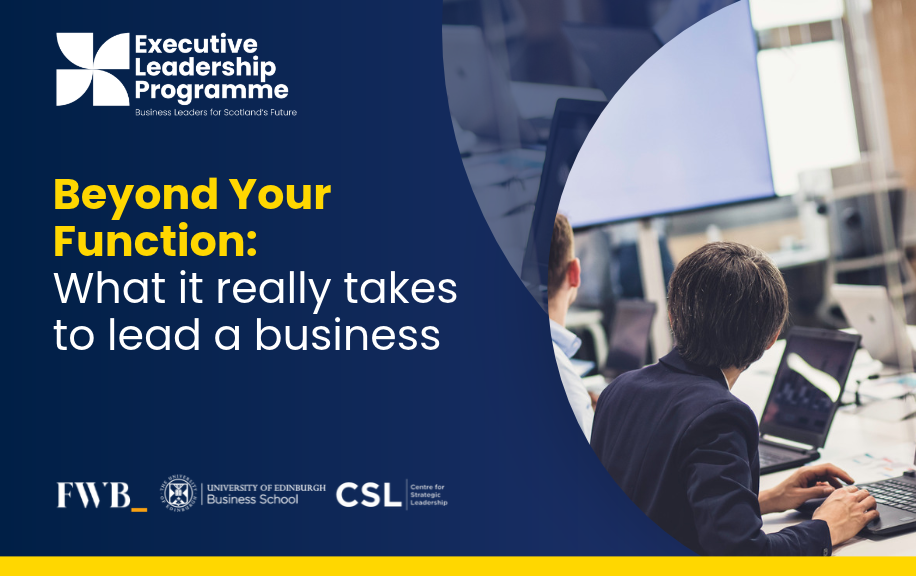
You can build a career on being exceptionally good at what you do. But what happens when your next role demands that you understand, influence and lead everything beyond it?
For Greg Michael, former Group CEO of Menzies Distribution, the journey from functional specialist to enterprise leader was anything but conventional. From becoming a partner in a London law firm in his late twenties to leading complex international acquisitions, navigating organisational transformation and ultimately running major businesses, his career has been shaped by opportunities, difficult decisions and lessons that could never have been learned from a textbook alone.
Speaking to participants on the FWB and University of Edinburgh Business School’s Executive Leadership Programme, Greg offered a candid account of what it takes to make that transition. Drawing on more than 25 years of senior executive experience, he shared the realities of leading organisations, the mistakes that shape judgement and why becoming an effective business leader requires far more than being successful in your own discipline.
His central message was clear. Enterprise leadership builds on your existing expertise and asks you to apply it more broadly. That means understanding the people and operations behind the numbers and having the confidence to take responsibility when the answers are unclear.
From Specialist to Business Leader
Greg began his professional career as a lawyer, becoming a salaried partner at a relatively young age. When a merger changed the direction of the firm, he began considering opportunities outside private practice. That decision began a career spanning legal, commercial, strategic and operational responsibilities, with international acquisitions, integration programmes and increasingly complex leadership positions at organisations including Deutsche Post and DHL.
A significant turning point came when he was asked to lead the UK EXPRESS integration associated with Deutsche Post’s acquisition of Exel Logistics. The challenges extended far beyond contracts, negotiations and legal risk. Thousands of employees faced uncertainty about their jobs and working conditions, while senior stakeholders were focused on delivering the financial outcomes of the transaction. Greg had to balance those commercial objectives with the concerns of the people affected by the change.
“Your functional expertise is never lost.”
For Greg, his legal training provided the discipline, analytical ability and confidence to navigate complex commercial situations. What changed was how he applied those capabilities and the breadth of responsibility he was prepared to take on. For aspiring enterprise leaders, the next step is to build on the expertise that has brought them success by seeking experience across different parts of the organisation.
You Cannot Lead a Business You Don’t Understand
“Understand the business from the bottom up so you can run it from the top down.”
Drawing on his experience at Menzies Distribution, Greg challenged delegates to consider how well they understood the operational realities behind the figures they were responsible for reporting or managing. For a finance leader, that might mean seeing how costs are incurred on the frontline. For someone in strategy, it could mean spending time with the people who will deliver a proposed change and understanding what it will ask of them. For a future CEO, it means seeing how those decisions connect across the business.
Greg encouraged leaders to spend meaningful time in the operational parts of their organisations, experiencing the pressures colleagues face and questioning assumptions that might otherwise go unchallenged. The more senior the role, the easier it is to rely on dashboards and financial reports. Spending time with the people doing the work gives leaders access to details that can make a difference to executive decisions.
Get Comfortable Being Uncomfortable
Greg’s route to becoming a CEO involved unexpected opportunities, setbacks and decisions that pushed him into unfamiliar environments. At one stage, after receiving feedback that his approach could be overly blunt, he took time away from work to complete an MBA. Later, leading complex integrations and international businesses called for skills and judgement that he could only develop by taking on that responsibility.
Greg encouraged delegates to seek out assignments that stretch their capabilities. That might mean volunteering for a transformation project, taking responsibility for an unfamiliar function or moving sideways into a role that offers greater commercial exposure. Those experiences can expose gaps in knowledge, challenge confidence and require leaders to draw on other people’s expertise. They also teach leaders when to seek advice, how to bring the right people together and how to make decisions when the information available is incomplete.
The People Around You Will Determine Your Success
For all the emphasis on strategy, commercial understanding and decision-making, Greg repeatedly returned to the people doing the work. He spoke openly about the pressure organisations can place on their strongest performers. When someone consistently delivers, the instinct can be to give them more responsibility, more complex problems and more work. Even the most capable people have a limit. Leaders need to recognise when colleagues are reaching it and respond by bringing in additional expertise, redistributing responsibilities or giving their teams better support.
That responsibility grows in enterprise leadership, where success depends on creating the conditions for others to perform. At Menzies Distribution, Greg gave promising junior colleagues opportunities to engage with board members, exposing them to situations they might otherwise have had to wait years to experience. He made preparation, coaching and support part of the process so they could come away more confident and capable.
For leaders developing future successors, identifying talent is the starting point. The work is in giving people meaningful opportunities to stretch themselves and making sure they have the backing to succeed.
Leadership Is Tested When Things Get Difficult
Greg was candid about the difficult situations that come with responsibility for an entire organisation. His experience of acquisitions and business integrations showed how much leaders’ judgement and credibility matter when they face competing stakeholder expectations, difficult conversations and decisions with uncomfortable consequences. He emphasised the importance of earning trust and respect before circumstances demand a decision that may be unpopular or personally difficult.
He also highlighted the need to adapt communication to different audiences. Frontline employees, investors and board members will have different questions about the same change. As their responsibilities grow, leaders need to understand what each group needs to hear and be aware of how their words, decisions and behaviour are felt across the organisation.
Think Beyond Your Job Title
Greg’s advice to aspiring executive leaders was practical. Build a reputation for delivering. Seek opportunities outside your immediate function. Spend time understanding how the business works. Ask for feedback, take it seriously and put yourself forward for responsibilities that challenge you.
At enterprise level, decisions have to account for the whole organisation. That means balancing competing priorities, understanding the commercial consequences of a decision and taking responsibility for outcomes beyond your own area of expertise. Greg’s career shows how that judgement develops over time, through exposure to unfamiliar work and a willingness to learn from both success and failure.
For anyone looking to make that transition, a good place to start is with an assignment that gives you responsibility for a part of the business you know less well.
The Executive Leadership Programme is delivered in partnership by FWB and the University of Edinburgh Business School. Now in its sixth year, it brings together senior leaders from the private, public and not-for-profit sectors to develop the knowledge, perspective and capabilities they need for executive leadership. It builds on the Executive Women in Leadership and NXD Development programmes, which have supported more than 600 delegates in advancing their executive and non-executive careers.