 Executive Search
 Non-executive Search
 Management Due Diligence
 Market Mapping
 Remuneration Benchmarking
 Psychometric and Ability Testing
 Executive and Non-executive Education
 Built Environment and Support Services
 Consumer
 Energy Transition
 Engineering and Manufacturing
 Financial Services
 Private Equity and Venture Capital
 Professional Services
 Public Sector and Not For Profit
 Technology and Life Sciences
 Chair and Non-Executive Director
 CEO
CEO CFO and Financial Management
 Operations and General Management
 Commercial
 Human Resources
 IT, Digital and Technology
 Manufacturing, Supply Chain and Logistics
 Legal and Governance
Contact the team at FWB to discuss your individual or company requirements, or to discover more about our specialist services.
Building for Scale, Not Sale: Insights from Scotland’s Scale-Up Leaders
Events
27 January 2026
- FWB Events
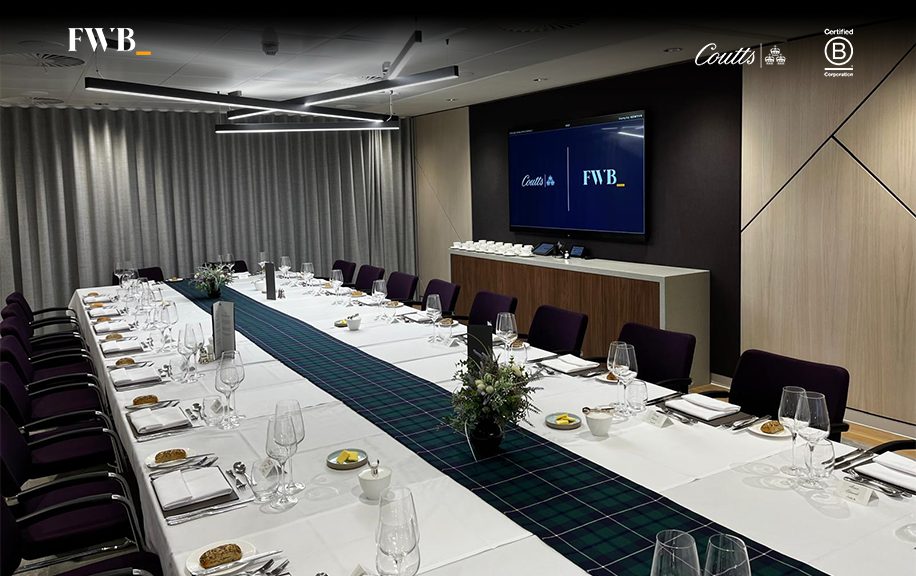
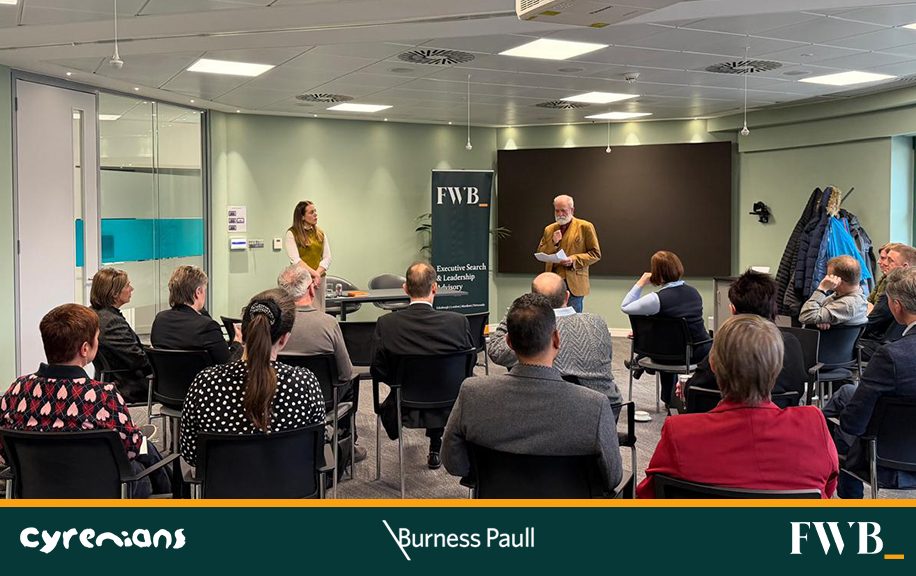
Last week FWB Executive Search in partnership with Coutts hosted a Scale-Up Dinner in Edinburgh, bringing together founders, senior executives, non-executive directors, investors, and advisors from across Scotland’s scaling business community.
Held under the Chatham House Rule, the evening featured reflections from Shane Corstorphine, drawing on his experience scaling businesses in Scotland and internationally, alongside insights from his recent work leading the Scaling Scotland report for the Scottish Government.
The discussion centred on what must change if Scotland is to create the next generation of billion-pound companies. Key themes included:
We must build companies for scale, not just for sale.
Scotland has the founders, ideas, and drive. What is now required is shared commitment — from both public and private leaders — to support businesses through the full scale-up journey.
Founder exhaustion is a real barrier to ambition.
Reaching £5m of equity value in Scotland is hard. Limited access to capital can be exhausting, making early exits more attractive than continuing the journey to significant scale.
Scotland lacks leaders with lived scale-up experience.
Too few businesses have scaled to meaningful size, limiting the available talent pool. As a result, boards often skew towards corporate experience rather than true scale-up expertise.
Risk aversion can slow momentum at critical moments.
Corporate experience is valuable, but can introduce caution where speed and bold decision-making are required to compete globally.
Faster decision-making is essential.
Those with genuine scale-up experience should move from advising into directing, enabling boards and management teams to execute strategy at pace.
Scotland should leverage its size to be more nimble.
As a small country with a big opportunity, Scotland should be able to move faster — yet bureaucracy often gets in the way.
Competitiveness matters — including taxation.
Tax policy was discussed as a potential lever to make Scotland a more attractive place to found and scale large businesses, with international comparisons offering useful lessons.
Attracting and accessing talent must be easier.
Innovative approaches, such as fractional leadership models, could help scale-ups access world-class talent more flexibly.
Businesses must pay for the very best talent.
Scaling successfully requires deliberate investment in leadership — including engaging professional executive search partners rather than relying solely on personal networks.
Equity incentivisation is critical.
Aligning key leaders through meaningful equity participation is essential to balancing risk, reward, and long-term value creation.
Capital constraints create resilience — but also limits.
Scottish businesses are often highly disciplined and resilient, but lack of capital can restrict ambition if not addressed.
Sales capability remains a competitive weakness.
Scotland produces exceptional products and technology, but often under-invests in sales talent and go-to-market capability compared with competitors, particularly in the US.
Founders must be willing to follow the market.
Commercial scale and growth capital are often located outside Scotland — frequently in the US. Founders should be prepared to relocate or spend significant time where their customers, investors, and partners are, while retaining strong roots at home.
Great investors make a disproportionate difference.
The most valuable advice often comes from the most demanding investors. Boards exist to ensure management delivers against the agreed strategy and builds for scale.
We must celebrate success more openly.
Scotland is passionate about supporting its own businesses, but needs to do more to celebrate success and resist the cultural drag of envy.
Government policy underpins all of this.
To unlock large-scale entrepreneurship, government must create the conditions — and the culture — for ambition at scale, not just early-stage success. Scotland generates an exceptional volume of ideas and young businesses, but too many are acquired and scaled elsewhere. Policy has a critical role to play in ensuring more of these businesses grow to global scale here in Scotland.
Encouragingly, the discussion also highlighted that Scotland — and Edinburgh in particular — is attracting ambitious founders from elsewhere. One CEO of a rapidly scaling business shared his experience of founding his company in a smaller European country before deliberately choosing to relocate the business to Edinburgh. For him, Edinburgh offered the right balance: exceptional talent, a strong and collaborative culture, and a scale that felt more connected and accessible than London, which he viewed as too large and distant. His decision was driven not by compromise, but by conviction — a belief that the conditions here are genuinely right for building something significant. It was a timely reminder that while Scotland can be self-critical, there is much here that is world-class and increasingly recognised by those choosing to build and scale businesses from the outside in.
The evening reinforced a clear message: Scotland has the ingredients to produce globally significant companies. The challenge now is collective will — across founders, investors, advisors, and policymakers — to back ambition all the way to scale.