 Executive Search
 Non-executive Search
 Management Due Diligence
 Market Mapping
 Remuneration Benchmarking
 Psychometric and Ability Testing
 Executive and Non-executive Education
 Built Environment and Support Services
 Consumer
 Energy Transition
 Engineering and Manufacturing
 Financial Services
 Private Equity and Venture Capital
 Professional Services
 Public Sector and Not For Profit
 Technology and Life Sciences
 Chair and Non-Executive Director
 CEO
CEO CFO and Financial Management
 Operations and General Management
 Commercial
 Human Resources
 IT, Digital and Technology
 Manufacturing, Supply Chain and Logistics
 Legal and Governance
Contact the team at FWB to discuss your individual or company requirements, or to discover more about our specialist services.
Scotland’s Energy Future: How do we balance transition, security and growth?
Leadership Development
15 December 2025
- FWB Events
- Leadership
- Leadership Development
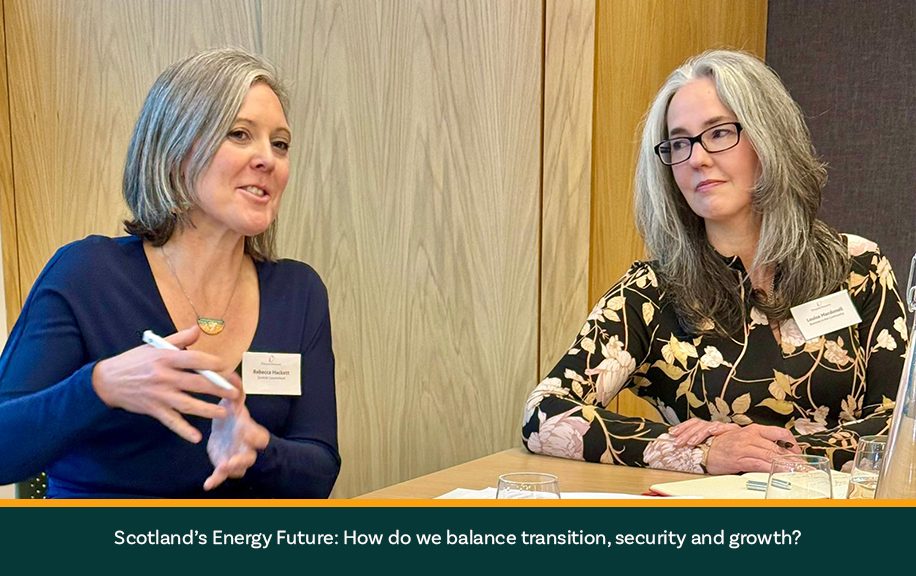
As Scotland moves toward its 2045 net-zero target, the nation faces a pivotal juncture. The Just Transition plan sets out a bold vision for a climate-friendly, affordable and resilient energy system – but the path to get there is increasingly complex. With the 2026 Scottish Parliamentary election on the horizon, debates around energy security, the future of oil and gas, infrastructure investment and national resilience are intensifying.
Against this backdrop, the Executive Leadership Programme (ELP) alumni community convened a panel of senior leaders to explore the realities behind Scotland’s energy transition. Hosted at Pinsent Masons in Edinburgh, the session brought together:
- Dan McGrail, CEO of GB Energy
- Vanya Kretschmar, VP of Wood Mackenzie
- Sandy Trust, Director of Sustainability Risk of Baillie Gifford
- Michael Watson, Partner & Head of Climate & Sustainability Advisory of Pinsent Masons
- Louisa MacDonnell, Scotland Director of Business in the Community & Just Transition Commissioner
A Decade of Underinvestment Meets a Decade of Urgency
Dan opened with a stark assessment: Scotland has underinvested in energy infrastructure for at least ten years. Electricity accounts for just 20–25% of total energy use; the rest still comes from oil and gas. To electrify heating, transport and industry at the scale required, the grid must expand dramatically.
Yet the system is already strained. Lead times for transformers have stretched from one year to four. SSE has announced £33 billion of network investment, with similar commitments expected from National Grid.
Dan identified four structural blockers slowing progress:
- Supply chain constraints
- Planning delays
- Skills shortages
- Network capacity limits
These are not quick fixes. They require long-term, coordinated action.
2030: Catalyst or Constraint?
Michael highlighted the paradox of the 2030 targets: they create urgency, but they can also distort long-term decision-making. The transition is “the greatest growth opportunity of our time,” he said, but political uncertainty and shifting grid demands make delivery difficult.
Dan added that many offshore wind projects being built today were formulated during Gordon Brown’s leadership, a reminder that energy infrastructure operates on multi-decade cycles. The question is not whether 2030 is achievable, but whether it helps or hinders strategic clarity for the 2040s and beyond.
GB Energy’s recently published strategic plan, focuses on three priority areas:
1. Offshore Energy
The UK’s global success story: Moving from demonstration to commercialisation to industrial scale. Long-term decarbonisation relies heavily on offshore wind, and the next phase requires de-risking to unlock investment.
2. Onshore Energy
A major opportunity to accelerate deployment and provide certainty for developers, unlocking the energy potential of land, and strengthening stability across the country.
3. Local and Community Energy
Ensuring the transition delivers tangible, place-based benefits, ensuring that communities and public services directly benefit from the clean energy infrastructure in their area.
Yet no discussion of Scotland’s energy future can ignore the role of oil and gas…
Oil and Gas: A False Binary
The conversation sharpened when the Chair asked about phasing out oil and gas.
Vanya urged a pragmatic lens: globally, oil demand is rising, gas demand is “rocketing,” and AI data centres are accelerating consumption. No major economy is on track for net zero, and no global plan exists to phase out hydrocarbons.
Against that backdrop, she argued, the UK’s rapid retreat from domestic oil and gas risks:
- undermining energy security
- destroying economic value
- accelerating job losses (potentially 80,000 in five years)
- increasing reliance on imports from countries with weaker climate standards
Norway drilled 40 exploration wells in 2025; the UK drilled none.
Dan countered that the debate is often framed incorrectly. The UK is not “phasing out” oil and gas – it simply cannot electrify fast enough to replace it. Even with unlimited capital, the supply chain cannot deliver the necessary equipment.
Crucially, he noted, the boundary between oil and gas and renewables is already blurred. Offshore wind relies on the same engineering and marine expertise that built the North Sea. Many “lost” jobs are, in fact, transferable – if the transition is managed well.
The Economics of Electrification
Our panel pointed to the automotive sector as a bellwether: in 2023, 99% of global R&D spending went into electrification and automation, with only 1% into combustion engines. Internal combustion will become niche and expensive; electricity is the growth market, even if fossil fuels still generate some of that electricity in the near term.
Sandy added that Scotland is full of solvable problems — but investors need investable projects, not just ambition.
A Just Transition: The Human Dimension
Louisa grounded the discussion in social reality. Poorly managed transitions leave scars, as seen in former mining communities. Today, many low-income households rely on gas because electricity is four times more expensive. Turning off gas without addressing affordability would cause profound social harm.
She emphasised:
- Scotland has capital, but not enough projects.
- Communities must be engaged early and honestly.
- “Net zero” has become a toxic phrase in some circles, but nearly 60% of Scots still support it.
- Places like Grangemouth illustrate the complexity: many workers are transient, but local businesses depend on the industry’s presence.
What Leaders Need Now
The panel closed by reflecting on the skills required for modern leadership in the energy transition:
- Systems thinking, not siloed decision‑making
- Energy and climate literacy, including geopolitics and economics
- Understanding networks and ecosystems, not just organisational hierarchies
- Ability to separate signal from noise
- Humility and collaboration, recognising that no single organisation has all the answers
Understanding climate sensitivity and tipping points is essential – averages won’t guide us through what comes next. Leaders must embrace uncertainty and resist the temptation to oversimplify complex problems. Collaboration remains the only credible route forward. What Scotland chooses to do next will determine whether this transition is remembered as a period of disruption or as the foundation of a more resilient and more prosperous future.